
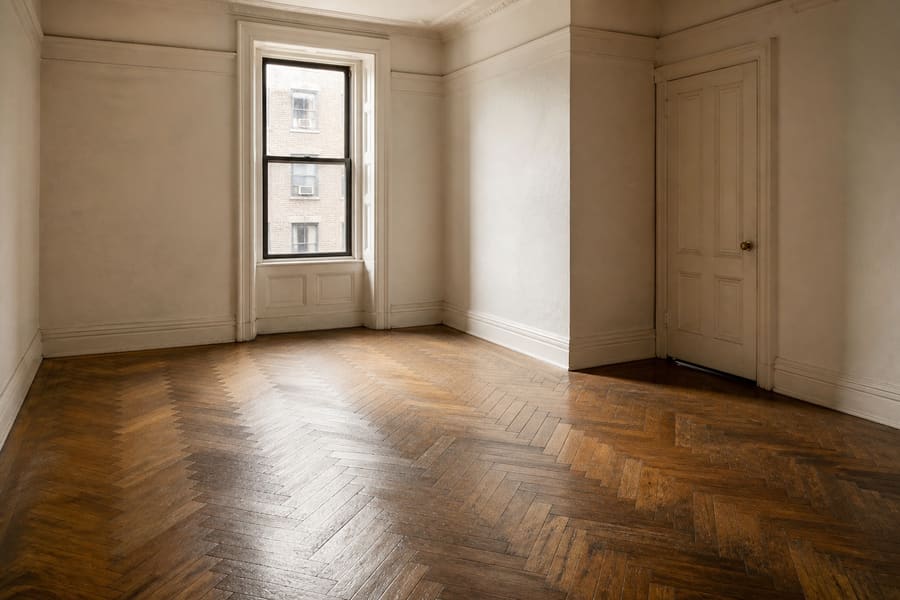
Prewar apartment houses
Matching is the whole job here. Parquet, herringbone and old strip widths, laid in patterns that need cutting to rather than buying off a shelf.
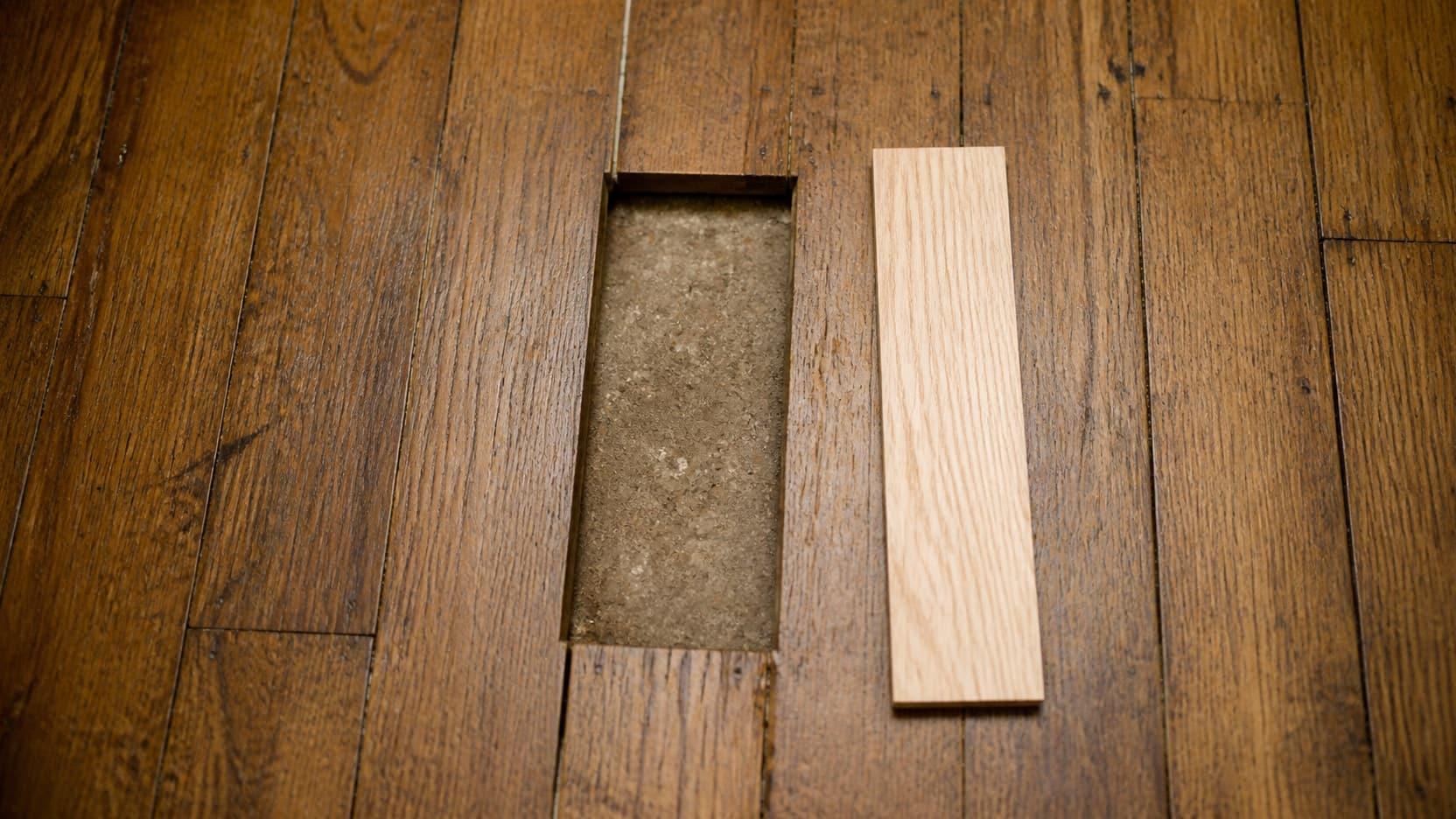
Most wood floor damage is local. A floor with a bad patch is usually not a floor that needs replacing, and the sooner it is looked at the less of it there is to put right.
Damage that has affected part of a floor rather than wear that has affected all of it. The boards around it are sound, and the job is to put the bad area right and blend it into what is already there.
In Manhattan the familiar repairs are water damage from a leak or from the apartment above, boards that have gone loose or started to squeak, gaps that open every winter, and gouges from furniture or a pet.
The other thing we see a lot is a floor that somebody else has already patched. A repair done in the wrong species, the wrong grain direction or the wrong board width is visible forever, and putting it right is a different job from the original one.
Find the one that matches and you will know roughly what you are looking at.
Boards go dark, then grey or black, and often cup as they take up moisture. The fix depends on how long the water sat there. Caught early it can be dried and refinished, and left longer the boards have to come out.
The board has come away from what it is fixed to, or the subfloor underneath has moved. Squeaks are usually fixable from above without lifting the floor, and the cause matters more than the noise.
Normal seasonal movement in a solid floor, and much more pronounced in a steam heated building. Manhattan winters are dry and hot indoors, so the wood shrinks. Most of these gaps close again in summer.
Damage into the wood in specific places. Small ones can sometimes be filled and blended, and deeper ones mean replacing the board so the repair does not read as a dark line.
The boards are curved across their width, up at the edges or up in the middle. This is a moisture problem, not a floor problem, and finding where the moisture is coming from comes before any repair.
Wrong species, wrong direction, wrong width, or filler used where a board was needed. We take it back out and do it properly, which is usually a smaller job than people expect.
This is a question worth answering properly, because the usual advice is wrong for this borough.
Wood takes up moisture from the air and gives it back. In a steam heated Manhattan building the winter air indoors gets very dry, the boards shrink across their width, and gaps appear between them. In summer the humidity comes back, the boards swell, and the gaps mostly close.
That means filling them in January is a bad idea. The filler goes in at the widest point, then the wood expands in summer with nowhere to go, and the boards crush against each other or push the filler out. Either way the floor is worse off.
Gaps worth filling are the ones that are still there in the humid part of the year. Those are permanent and they can be dealt with. We would rather look at your floor in summer and tell you it needs nothing than take money for a repair that undoes itself.
Send us a photograph of the damage and we can usually tell you what it is.
Call (929) 207-0334A repair in a prewar apartment is a matching problem as much as a carpentry one. Original strip, parquet and herringbone floors were laid in widths and patterns that are not what a supplier stocks today, and the wood itself is old growth oak with a tighter grain than new timber.
We match on species, grain direction, board width and thickness, and we source reclaimed material where a new board will not sit right. Where a floor has an unusual pattern we cut to the pattern rather than approximating it.
Here is the honest part. A repair in an old floor that has aged and darkened for a century will be a very good match, and under close inspection in raking daylight you may still find it. Where a floor is being refinished after the repair the match gets better, because sanding and finishing bring everything to the same surface. We will tell you which of those you are getting before we start rather than afterwards.
There is a point where fixing patches stops being the cheaper option, and it is worth knowing where it is.
The damage is in a defined area, the rest of the floor is in good condition, and you are happy with how the floor looks generally.
There are several damaged areas across the floor, or the surface is worn everywhere anyway. Repairing then refinishing the whole floor gets you one even surface for not much more.
New wood never matches an aged finish exactly. If the floor is being sanded and refinished after the repair, everything comes to the same colour and the repair effectively disappears. That is often the reason to do both together.
Matching is the whole job here. Parquet, herringbone and old strip widths, laid in patterns that need cutting to rather than buying off a shelf.
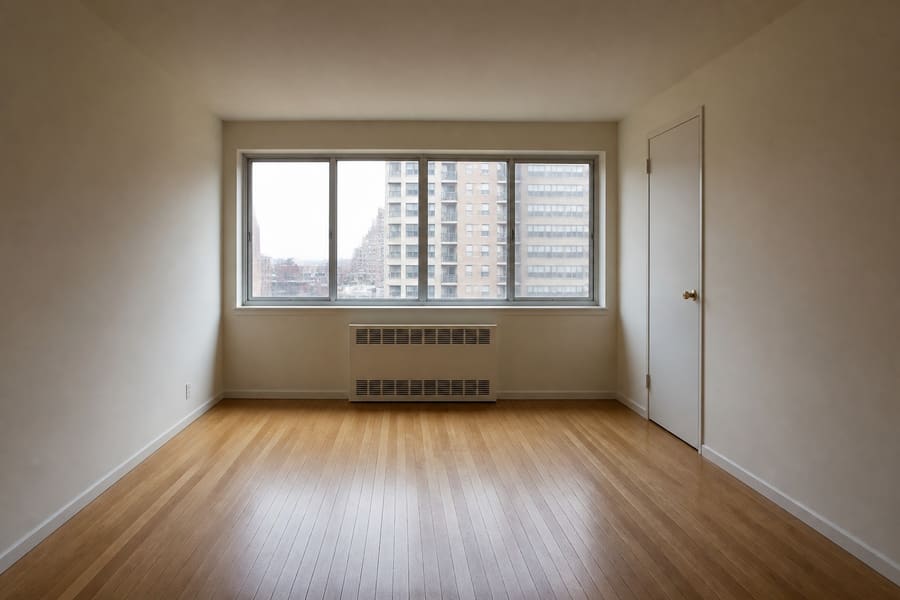
Often thin or engineered floors where a damaged board has to be taken out cleanly rather than sanded around, because there is little thickness to work with.
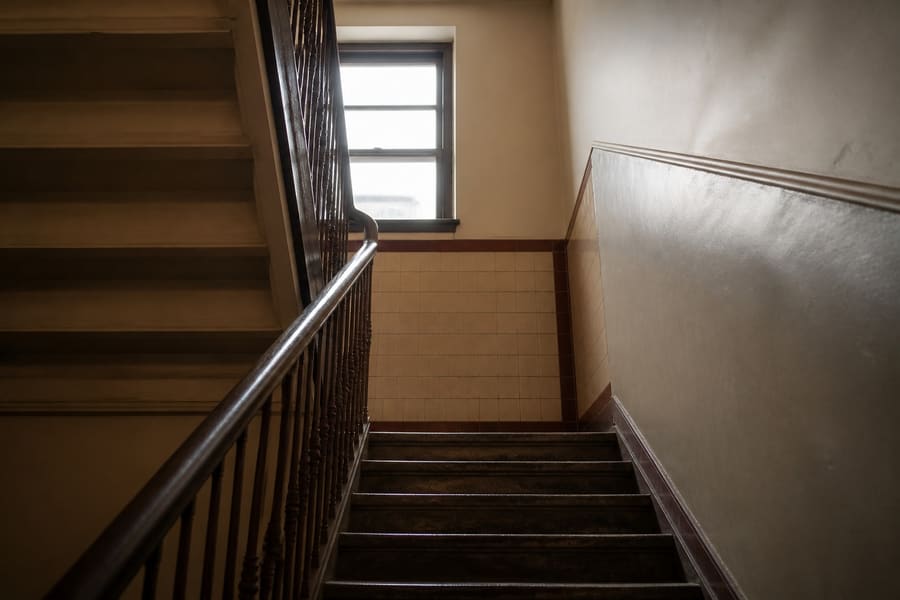
A repair is a small job to get into a building, which is an advantage in a walk-up. Loft floors are wide plank, so a replacement board is a bigger visual piece and matching matters more.
Repairs are quoted on the area and on what caused the damage, because the cause decides how much has to come out. A few boards is a small job and water that has been under the floor for months is not.
Matching affects it too. A common oak strip is straightforward, and an unusual prewar parquet pattern that needs sourcing and cutting takes longer.
If the damage is in a defined area and the rest of the floor is sound, it is a repair. That is most of what we see.
Once there are several damaged areas, or the whole floor is worn anyway, repairing and then refinishing the lot usually costs little more and gives you a much better result.
It will be a good match and in most rooms you will not pick it out. In raking light, on a floor that has aged for a century, somebody looking for it may still find it.
If we refinish the floor after the repair, everything comes to one colour and surface and the repair effectively disappears. We tell you which outcome you are getting before we start.
Usually. We match species, grain direction, thickness and the pattern itself, and we use reclaimed material where new wood will not sit right against hundred year old oak.
Send us a photograph with something for scale. Pattern and board width are normally readable from that.
Not if they close up again in summer. Those are seasonal and filling them at their widest is how boards end up crushed or filler ends up on the surface.
Gaps that stay open all year round are permanent and can be dealt with. The right time to judge is the humid part of the year, not January.
Get the leak stopped first, then let us look before anything is decided. Wood that has been wet often looks worse than it is once it dries out, and drying can take weeks.
The mistake is repairing too early. If boards are replaced while the subfloor underneath is still wet, the new work moves and you pay twice.
Describe the damage and roughly how big an area. That is usually enough to place it.
Call (929) 207-0334The whole floor is worn rather than damaged in one place.
Surface wear only, with the wood underneath still sound.
The floor has failed across enough of its area that replacing it is the honest answer.
What the damage looks like, roughly how big an area, and whether you know what caused it. A photograph in daylight is usually enough for us to place it.